hello@livey.us

Hybrid Work Is No Longer a Trend — It’s the New Operating Model
The way we work has fundamentally changed.
What started as a temporary response to global disruption has now become a permanent shift in how organizations operate. Hybrid work is no longer an experiment or an employee benefit — it is the new operating model for modern businesses.
Today, companies are redesigning workflows, collaboration methods, and technology infrastructure to support a workforce that operates across offices, homes, and multiple geographies.
The Hybrid Work Shift: What the Data Tells Us
Recent workplace data highlights just how deeply hybrid work is embedded into daily operations:
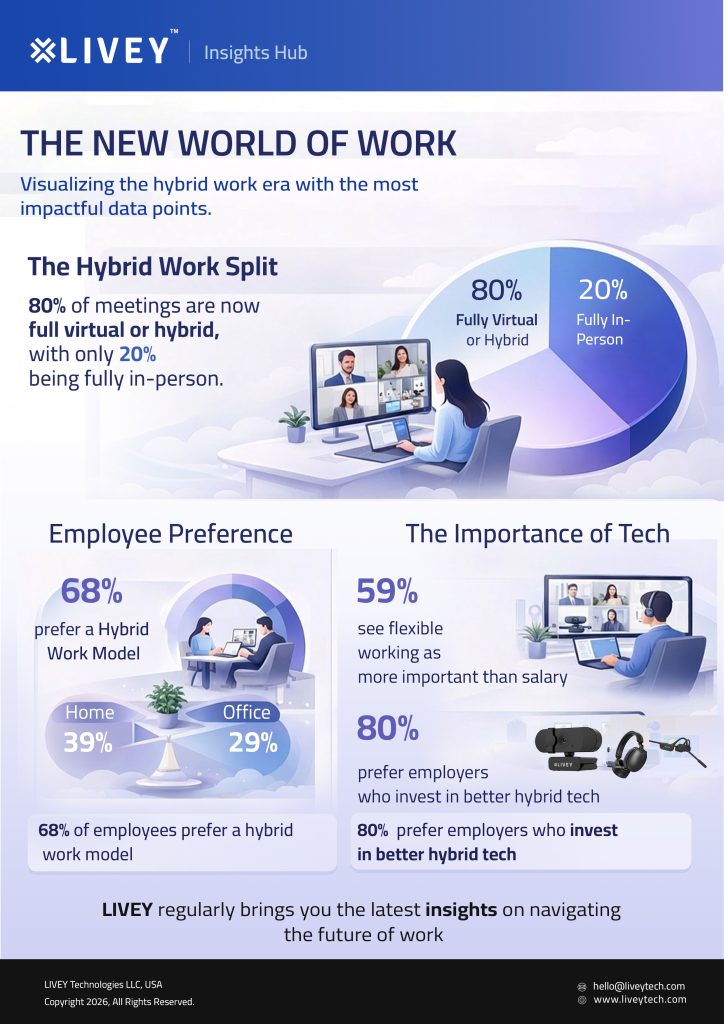
80% of meetings are now virtual or hybrid, with only a small portion happening fully in person
68% of employees prefer a hybrid work model over fully office-based roles
59% of professionals value flexible work more than salary
80% of employees prefer organizations that invest in technology to support seamless hybrid collaboration
These numbers make one thing clear:
Hybrid work is no longer about convenience — it’s about expectation.
Why Hybrid Work Became the Default Model
Hybrid work persists because it solves real organizational challenges.
1. Workforce Flexibility
Employees can balance productivity with personal responsibilities, reducing burnout and improving retention.
2. Access to Global Talent
Organizations are no longer limited by geography, enabling faster scaling and diverse hiring.
3. Cost Optimization
Reduced real estate dependency and better resource utilization lower long-term operational costs.
4. Continuity & Resilience
Hybrid operations allow businesses to remain functional during disruptions, travel limitations, or regional challenges.
The Real Challenge Isn’t Location — It’s Connection
While hybrid work offers flexibility, it introduces a new challenge:
How do teams stay connected when they are not in the same room?
Many organizations struggle with:
Inconsistent audio quality during meetings
Poor video framing and engagement gaps
Background noise disrupting conversations
Unequal participation between in-office and remote employees
When communication fails, collaboration suffers — and hybrid work becomes fragmented instead of productive.
Technology Is the Backbone of Hybrid Work
Hybrid success depends less on where people work and more on how well they connect.
Modern hybrid workplaces require:
Reliable audio clarity for uninterrupted communication
Intelligent noise suppression for noisy environments
High-quality video for engagement and presence
Seamless compatibility with collaboration platforms
Scalable solutions for enterprises and remote teams
This is why employees increasingly prefer organizations that actively invest in workplace technology.
The right tools don’t just enable meetings —
they create equity between remote and in-office participants.
Redefining Productivity in a Hybrid World
In traditional workplaces, productivity was measured by presence.
In hybrid environments, productivity is measured by:
Quality of communication
Speed of decision-making
Employee engagement
Meeting effectiveness
Collaboration experience
Organizations that align technology with these metrics consistently outperform those relying on outdated setups.
Hybrid Work Is a Long-Term Strategy, Not a Temporary Policy
The most successful companies are not asking whether hybrid work should continue.
They are asking:
How do we improve hybrid collaboration?
How do we reduce communication friction?
How do we create inclusive meeting experiences?
How do we future-proof our work environment?
Hybrid work is no longer managed by HR policies alone — it’s shaped by IT, infrastructure, and collaboration strategy.
The Future of Work Is Hybrid by Design
Hybrid work is not about splitting time between home and office.
It is about designing systems that work anywhere, anytime, for everyone.
Organizations that embrace this mindset will benefit from:
Higher employee satisfaction
Stronger retention
Better collaboration outcomes
Faster decision cycles
A future-ready workforce
Those that don’t risk falling behind — not because of talent, but because of outdated operating models.
Hybrid work is no longer a trend.
It is the new operating model for how modern businesses communicate, collaborate, and grow.
The companies that succeed will not be the ones with the most office space —
but the ones that build the strongest connections between their people