Blog Post
The Hidden Cost of Repeating Conversations in Customer Support
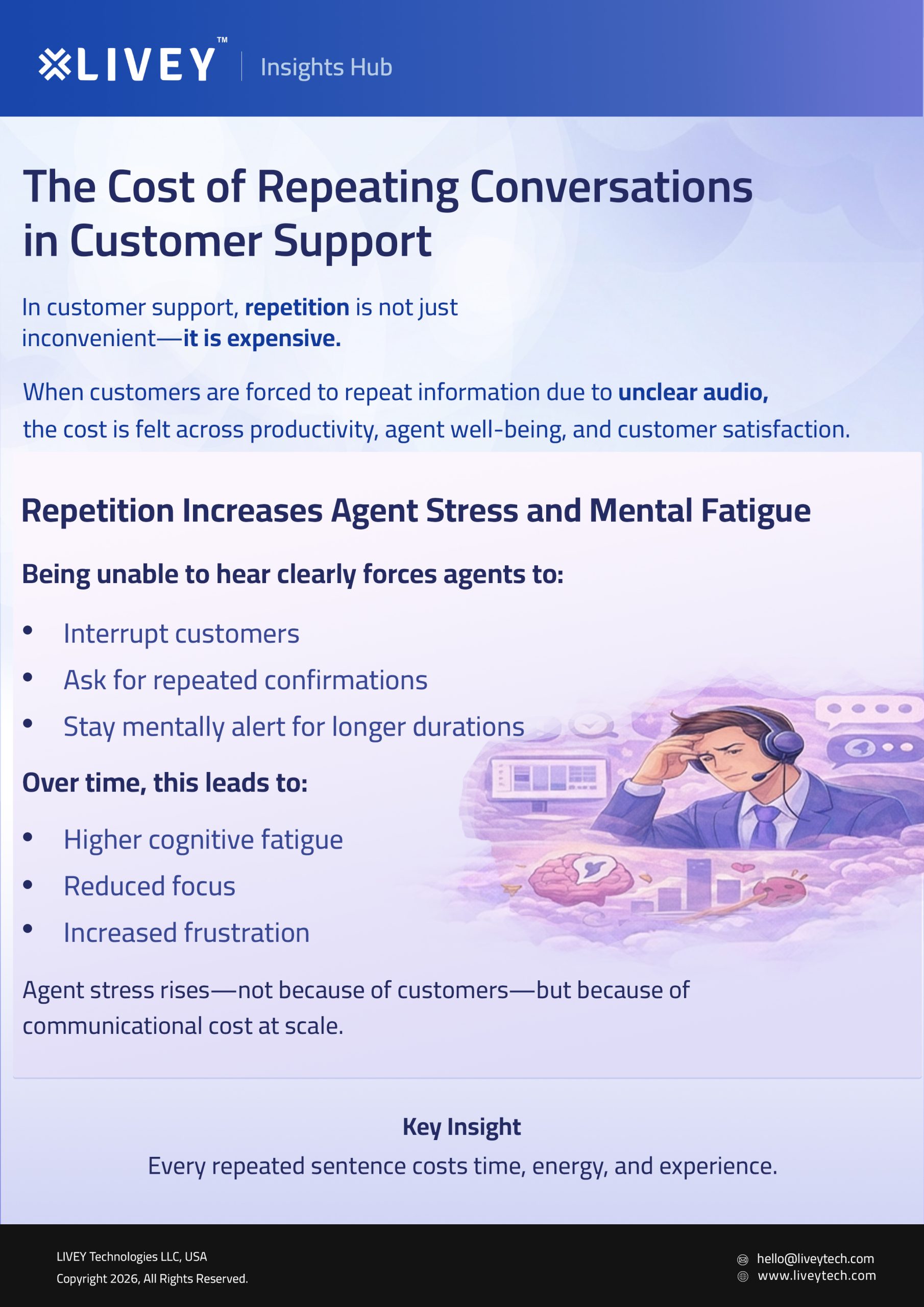
Why unclear audio increases operational cost faster than most teams realize
In customer support, repetition is often treated as a normal part of the process.
A customer repeats an issue.
An agent asks for clarification.
The conversation circles back before moving forward.
At first glance, this may seem like a small inconvenience.
In reality, repeated conversations create a compounding cost across customer experience, agent productivity, and operational efficiency.
What looks like a single repeated sentence often turns into a larger business problem.
Repetition Is More Than a CX Issue
Every time a customer is forced to repeat information, the support interaction becomes more expensive.
The cost is not limited to time.
It affects:
- average handling time (AHT)
- first call resolution (FCR)
- agent mental fatigue
- customer satisfaction scores
- team productivity metrics
When support teams operate at scale, even a few additional seconds per interaction can significantly increase operational load.
For example, if an agent handles 80–100 interactions in a shift, repeated clarification requests across multiple calls can add hours of inefficiency over a week.
How Poor Audio Creates Repetition
One of the biggest drivers of repeated conversations is poor call clarity.
When audio quality is inconsistent, agents often miss important details such as:
- names
- order IDs
- issue descriptions
- troubleshooting steps
- escalation context
This forces the conversation to restart in fragments.
Agents then need to interrupt naturally flowing conversations with repeated questions like:
- “Could you repeat that?”
- “I’m sorry, I didn’t catch that.”
- “Can you confirm the last part again?”
While these questions may seem harmless, they break trust and conversation momentum.
The Agent Experience: The Mental Cost of Repetition
Repeated conversations do not only frustrate customers.
They significantly affect agent well-being.
When agents constantly struggle to hear clearly, they are forced to remain in a heightened state of mental alertness.
This creates:
- higher cognitive load
- reduced focus
- faster fatigue buildup
- emotional frustration
Over time, this impacts agent confidence and performance.
The stress does not come from the customer.
It comes from the communication barrier.
This is often an overlooked reason behind rising burnout in support teams.
The Customer Experience Impact
From the customer’s perspective, repetition quickly becomes frustrating.
Customers are generally willing to wait.
What they are less willing to tolerate is being misunderstood.
The moment a customer has to repeat the same issue multiple times, the perception shifts from:
“They are helping me”
to
“They are not listening”
That emotional shift directly impacts trust.
And trust is central to customer satisfaction.
The Operational Cost at Scale
Let’s look at this from a business lens.
If each support interaction includes just 30–45 seconds of repeated clarification, and the team handles hundreds of calls daily, the accumulated cost becomes significant.
This impacts:
- support bandwidth
- queue wait times
- escalation volume
- staffing efficiency
Repetition increases cost per resolution.
It also reduces throughput.
This means fewer issues resolved per shift.
Why Audio Clarity Should Be Seen as an Operations Metric
Support leaders often track:
- response time
- resolution time
- CSAT
- ticket backlog
But audio clarity is rarely measured as an operational performance lever.
It should be.
Because communication quality directly influences:
- speed
- understanding
- resolution confidence
- customer sentiment
LIVEY : Better Conversations Reduce Cost
At LIVEY, we believe clear communication is not just a hardware issue.
It is a business efficiency issue.
When support teams are equipped with professional-grade audio solutions, the outcome is measurable:
- fewer repeated conversations
- lower agent fatigue
- improved FCR
- faster resolutions
- better customer trust
Because every repeated sentence carries a hidden operational cost.
And every clearly heard sentence moves resolution forward.
Repetition is not just an inconvenience.
It is a compounding cost across people, process, and experience.
In customer support, clarity is not optional.
It is operational infrastructure.