
Blog Post
AI Doesn’t Improve Communication. It Depends on It.
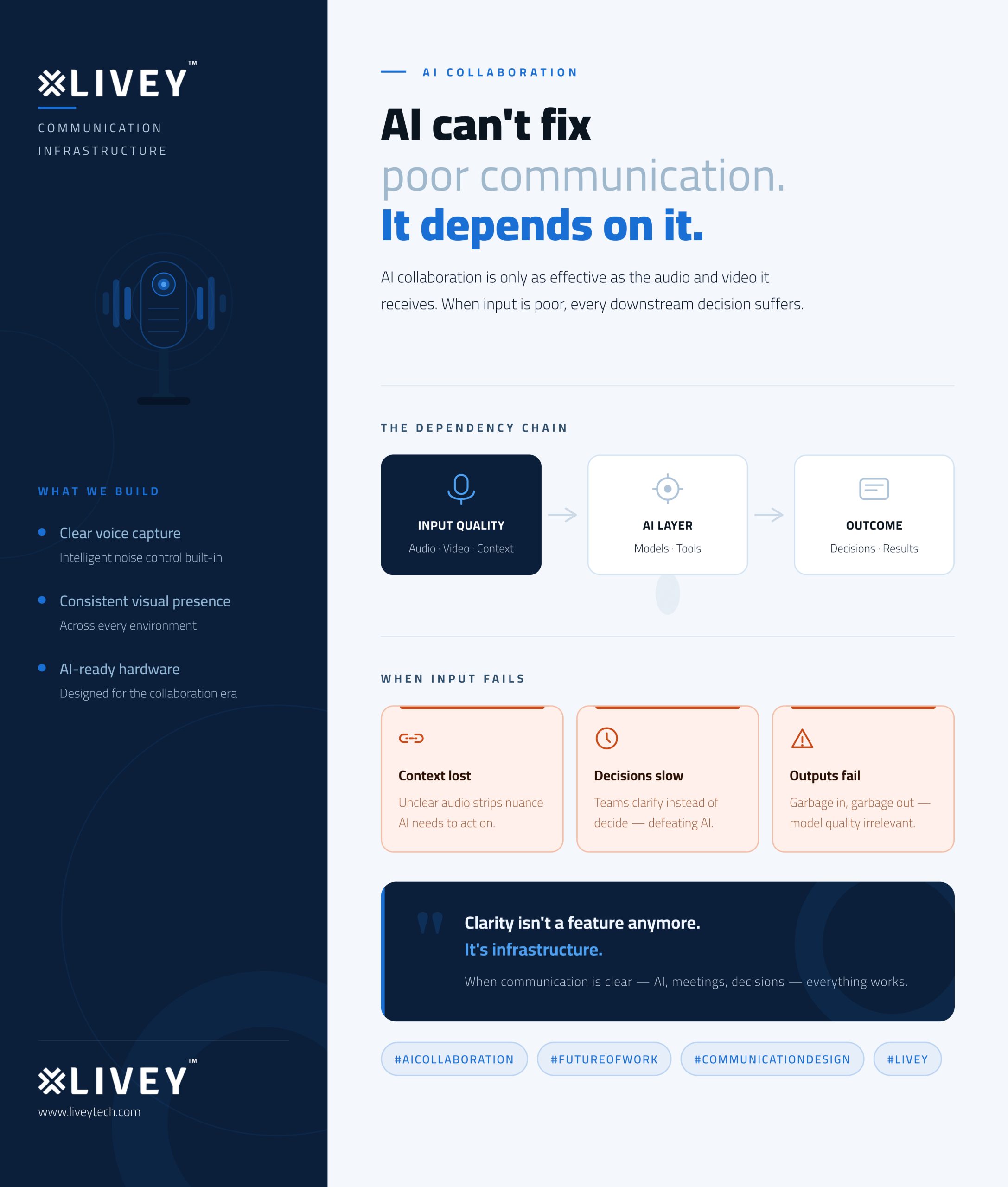
Most organizations today are investing heavily in AI-powered collaboration.
Smarter meeting tools.
AI summaries.
Automated workflows.
Real-time transcription.
Intelligent analytics.
But there’s a major assumption hiding underneath all of it:
that AI can somehow compensate for poor communication quality.
In reality, it can’t.
Because AI is only as effective as the input it receives.
If the incoming communication is fragmented, noisy, incomplete, or inconsistent, the entire downstream workflow becomes weaker.
That’s the hidden dependency chain most teams overlook:
Input → AI → Outcome
And if the first layer fails, everything after it becomes unreliable.
The Real Problem Isn’t AI Accuracy. It’s Input Quality.
Most communication failures don’t begin at the AI layer.
They begin before AI ever processes the interaction.
Unclear voice pickup.
Background noise.
Incomplete context.
Inconsistent video presence.
Fragmented conversations.
When communication quality drops:
- AI loses context accuracy
- summaries become less reliable
- transcripts miss critical information
- analytics lose precision
- teams spend more time clarifying discussions manually
The result is ironic:
organizations invest in AI to move faster —
but poor communication infrastructure slows everything back down.
Because instead of making decisions, teams start rechecking what was actually said.
Why Communication Infrastructure Has Become Strategic
For years, communication hardware was treated as a secondary IT purchase.
Headsets, webcams, microphones, and collaboration devices were considered operational accessories.
That approach no longer works in AI-driven workplaces.
Today, communication infrastructure directly affects:
- AI meeting intelligence
- workflow automation quality
- collaboration efficiency
- customer interaction accuracy
- operational decision-making speed
AI systems cannot create clarity from broken input.
They amplify whatever they receive.
Which means:
- good input improves AI outcomes
- poor input compounds confusion faster
This is why communication quality has become foundational infrastructure — not just a convenience feature.
The Hidden Cost of Weak Communication Input
When input quality fails, the damage spreads quietly across operations.
Context Gets Lost
AI systems struggle to interpret fragmented speech, overlapping conversations, or noisy environments.
Important details disappear before decisions are even made.
Teams Spend More Time Clarifying
Instead of progressing discussions, teams repeatedly confirm information, revisit conversations, and re-align understanding.
Momentum slows.
AI Outputs Become Less Reliable
Even advanced models become ineffective when source communication lacks clarity.
Because inaccurate input produces inaccurate outcomes.
No AI platform can fully solve “garbage in, garbage out.”
Why Organizations Need AI-Ready Communication Infrastructure
Most businesses focus heavily on software transformation.
But AI collaboration also depends on the physical communication layer behind it.
That includes:
- clear voice capture
- intelligent noise control
- stable collaboration hardware
- consistent visual communication
- reliable cross-platform performance
This is where communication infrastructure becomes critical.
At LIVEY, the focus is not just on communication devices.
The focus is on strengthening the source layer powering modern collaboration itself.
That means building hardware designed for:
- cleaner voice input
- distraction-controlled communication
- stable hybrid collaboration
- AI-ready meeting environments
- consistent communication quality across workspaces
Because when communication becomes clearer:
- AI systems perform more effectively
- meetings move faster
- teams make decisions sooner
- workflows become more predictable
Clarity Is No Longer a Feature
The biggest shift happening in modern work environments is this:
clarity is no longer optional.
In AI-powered collaboration environments, communication quality directly affects operational performance.
Organizations that improve input quality gain:
- faster alignment
- stronger collaboration
- more reliable AI outputs
- lower communication friction
- better workflow continuity
And organizations that ignore it eventually discover the same problem:
the smarter the AI becomes,
the more damaging unclear communication becomes.
Because AI cannot fix weak communication.
It depends on it.
And that’s why clarity is no longer just a feature.
It has become infrastructure.