
hello@livey.us
Most organizations assume communication problems are caused by slow workflows.
Too many meetings.
Too many discussions.
Too many approvals.
So the natural response becomes:
move faster.
Faster meetings.
Faster responses.
Faster collaboration tools.
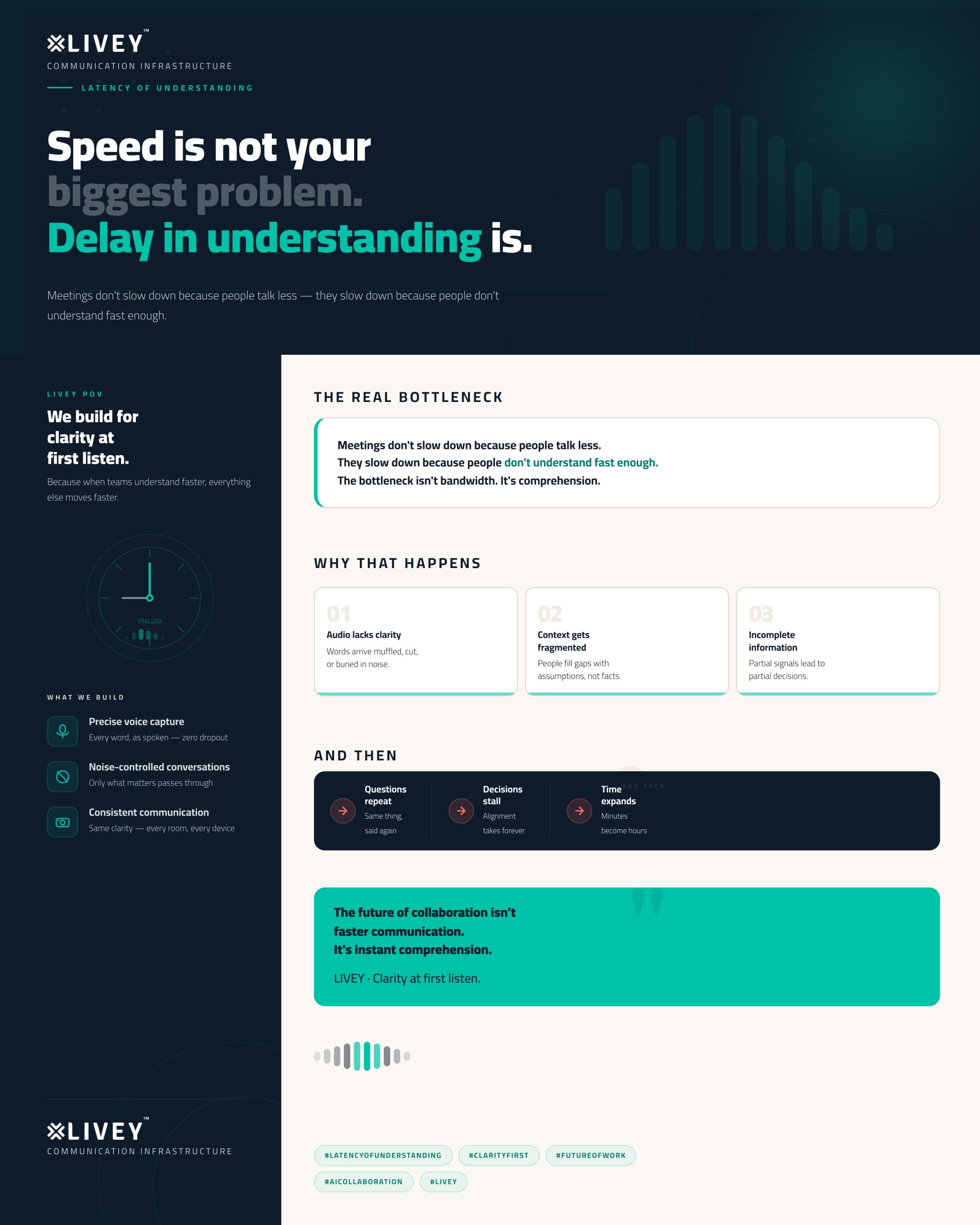
But speed is rarely the actual problem.
The real issue is how long it takes for people to fully understand each other.
Because most workplace delays don’t happen when people stop talking.
They happen when communication lacks clarity at the first point of listening.
In modern work environments, teams exchange information constantly.
Across:
The assumption is that communication is happening simply because words are being exchanged.
But communication is not just about transmission.
It’s about comprehension.
And when understanding is delayed, the entire workflow slows down.
That’s when teams begin to:
What looks like “collaboration” often becomes clarification.
And clarification consumes enormous operational time.
Most productivity loss in meetings happens quietly.
Not through dramatic failures —
but through small moments of friction repeated every day.
A sentence gets missed.
Context becomes fragmented.
Audio lacks clarity.
Someone misunderstands intent.
A team member asks for repetition.
Discussion momentum breaks.
Multiply this across dozens of meetings and conversations every week, and the business impact becomes significant.
Because delayed understanding creates:
The problem is not that teams communicate too little.
The problem is that comprehension happens too slowly.
For years, businesses focused heavily on internet speed and software performance.
But collaboration problems today are rarely caused by bandwidth limitations.
The real bottleneck is comprehension quality.
When communication signals are fragmented:
And no collaboration platform can fully solve unclear communication input.
Because teams cannot move faster than their ability to understand accurately.
That’s why communication infrastructure now plays a much larger role in operational performance.
In hybrid and AI-driven work environments, communication quality directly affects workflow speed.
Clear communication infrastructure supports:
This is where LIVEY focuses differently.
The goal is not simply enabling conversations.
The goal is enabling conversations that are understood immediately.
That means improving:
Because when teams hear clearly:
Many businesses believe future productivity will come from communicating faster.
But faster talking doesn’t create better collaboration.
Faster understanding does.
The teams that perform best are not always the ones communicating the most.
They are the ones losing the least clarity during communication itself.
That’s the real shift happening in modern workplaces.
Communication quality is becoming operational infrastructure.
Because when clarity happens at first listen:
And teams stop wasting energy trying to “re-understand” what was already said.
The future of collaboration isn’t speed alone.
It’s comprehension without friction.
Experience LIVEY for your Business
For more information on our “Products, Partnership Enquiries, FREE Sample Requests” feel free to get in touch with us.