hello@livey.us

Blog Post
Why Communication Infrastructure Has Become a Workplace Productivity Driver
Most Communication Problems Don’t Start With People
In modern workplaces, teams often assume productivity issues are caused by:
- poor coordination
- delayed responses
- inefficient meetings
- lack of collaboration
But in many cases, the real problem starts much earlier.
It starts with communication infrastructure.
Unstable audio, background distractions, uncomfortable headsets, and inconsistent voice clarity quietly affect how teams interact throughout the day.
And over time, those small communication gaps create larger operational problems:
- conversations become repetitive
- focus drops faster
- collaboration slows down
- fatigue increases across long work sessions
The issue is not simply “call quality.”
It is workflow disruption caused by inconsistent communication experiences.
Collaboration Fails Before Meetings Even Begin
Most organizations think collaboration breaks during meetings.
In reality, collaboration often fails at the input level:
- what people hear
- how clearly voices are captured
- how consistently teams can communicate without interruption
When communication clarity becomes inconsistent:
- employees repeat themselves
- discussions lose momentum
- context gets fragmented
- response quality decreases
- attention shifts from collaboration to clarification
This creates hidden friction inside everyday workflows.
And unlike visible operational problems, communication friction accumulates silently throughout the day.
The Productivity Cost of Poor Audio Consistency
Teams handling continuous communication workflows experience this most heavily:
- customer support teams
- operations teams
- hybrid workforces
- remote collaboration environments
- internal coordination departments
When audio quality fluctuates across calls and meetings:
- understanding slows down
- conversations require repetition
- collaboration becomes mentally exhausting
- employees lose focus faster during long sessions
Over time, this directly impacts:
- productivity consistency
- response efficiency
- collaboration quality
- employee comfort
- operational flow
The business impact is larger than most organizations realize because communication sits underneath nearly every workflow inside modern work environments.
Why Consistent Communication Infrastructure Matters
Organizations invest heavily into:
- collaboration software
- workflow systems
- automation tools
- AI platforms
- operational processes
But communication hardware still determines how effectively those systems function in real-world usage.
When communication devices fail to support clarity:
- workflows slow down
- meetings become fragmented
- understanding takes longer
- interruptions increase
- collaboration quality becomes inconsistent
This is why communication reliability is becoming a core operational requirement rather than a secondary IT consideration.
Designed to Reduce Communication Friction at the Source
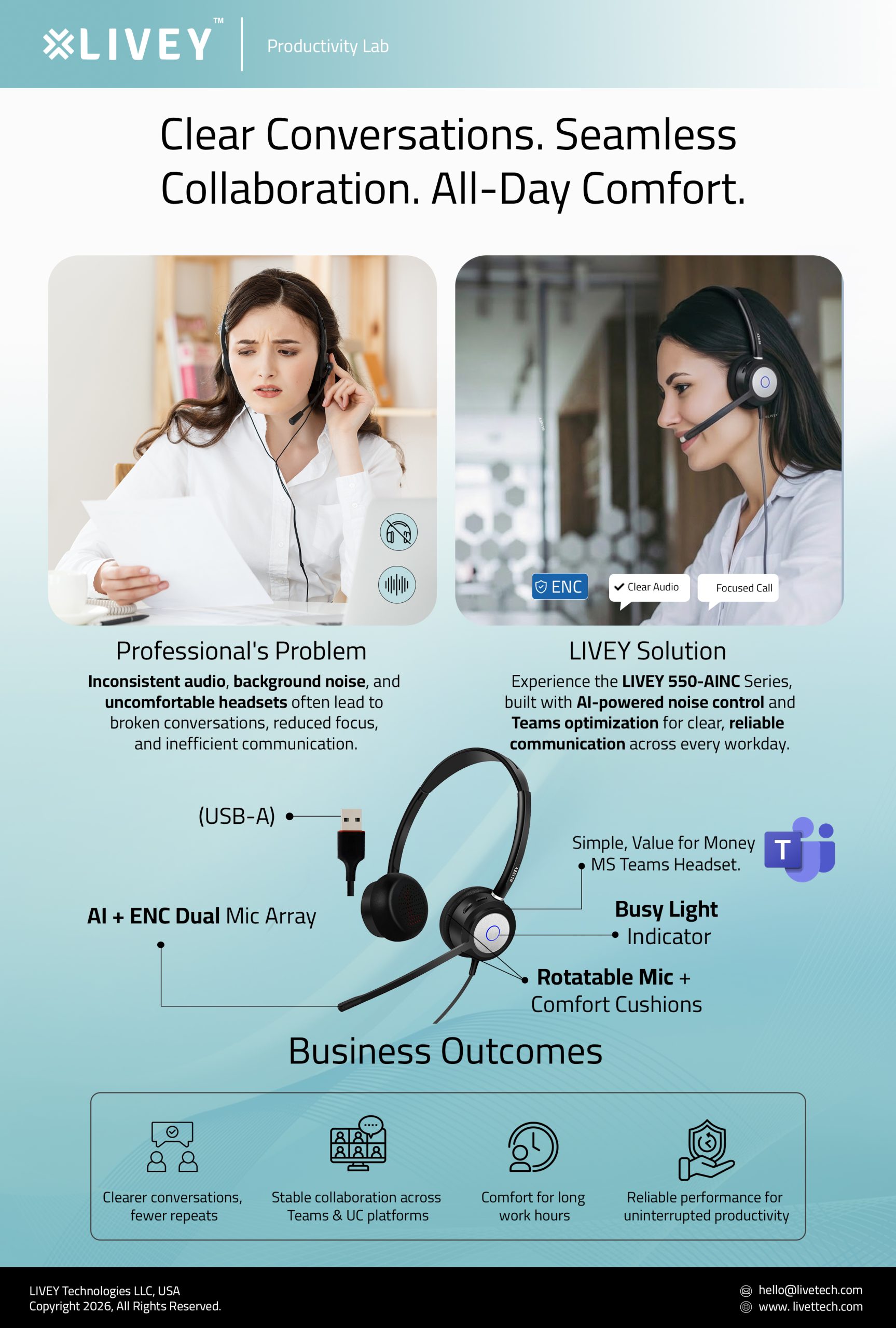
The LIVEY 550-AINC Series is designed around a practical workplace challenge:
making communication clearer, more consistent, and easier to sustain throughout long workdays.
Its communication-focused design includes:
- AI-powered noise control for distraction reduction
- ENC dual microphone clarity for focused voice pickup
- Stable USB-based communication for reliable connectivity
- Microsoft Teams optimization for smoother collaboration workflows
- Rotatable microphone flexibility for adaptable usage
- Cushioned ergonomic comfort for long-duration wear
- Busy light indicators to reduce unnecessary interruptions
Instead of treating communication as a passive utility, the system focuses on improving communication consistency across daily workflows.
Why Ergonomics Matter in Communication Performance
Communication quality is not only about microphones and audio processing.
Comfort directly affects communication performance too.
When professionals wear uncomfortable headsets for long hours:
- concentration decreases
- fatigue builds faster
- engagement drops during conversations
- overall communication effectiveness suffers
This becomes especially important in:
- support operations
- customer experience environments
- hybrid meetings
- long-duration collaboration workflows
Thoughtful ergonomic design helps maintain consistency throughout the day, reducing both physical and cognitive fatigue.
Better Communication Creates Better Workflow Stability
When communication becomes more reliable:
- conversations move faster
- repetition decreases
- understanding improves earlier
- meetings become smoother
- workflows feel more predictable
The operational impact becomes visible quickly:
- fewer interruptions
- better collaboration continuity
- reduced communication fatigue
- stronger day-to-day workflow consistency
This is where communication infrastructure directly influences workplace performance.
Clarity Has Become a Performance Layer
Modern organizations no longer operate in single-location environments.
Teams move continuously between:
- office collaboration
- hybrid workflows
- remote communication
- platform-based meetings
- real-time operational discussions
In these environments, communication clarity is no longer optional.
It directly affects:
- team efficiency
- collaboration speed
- decision-making flow
- employee productivity
- customer interaction quality
The LIVEY 550-AINC Series is built around this shift:
making communication reliable enough to support modern work without adding friction to it.
Because in high-collaboration environments, clarity is no longer just a feature.
It has become a performance driver.