Why Everyday Communication Friction Quietly Reduces Workplace Productivity
Most workplace communication problems don’t begin with major technical failures.
They begin with small interruptions that repeat throughout the day.
Background noise during calls. Repeated explanations. Unclear voice pickup. Mentally exhausting conversations. Inconsistent collaboration experiences across teams.
Individually, these issues seem minor.
But across hundreds of calls, meetings, and conversations every week, they slowly reduce communication efficiency, employee focus, and workflow momentum.
And in modern work environments where communication happens continuously, those small gaps compound faster than most organizations realize.
The Hidden Cost of Repeated Conversations
In office, hybrid, and support-based workflows, communication speed directly affects operational performance.
When conversations are not clear the first time:
people repeat information
discussions take longer
context gets fragmented
attention drops
mental fatigue builds throughout the day
This creates friction that often goes unnoticed because it doesn’t appear as a “major problem.”
But over time, it impacts:
collaboration quality
employee productivity
customer interactions
workflow continuity
response efficiency
The issue is not simply audio quality.
It’s communication consistency.
Why Communication Hardware Matters More Than Teams Think
Many organizations invest heavily into collaboration software and workflow systems but underestimate the role communication devices play in day-to-day performance.
Even strong collaboration platforms become less effective when:
microphones fail to isolate voices properly
background noise interferes with conversations
audio lacks clarity during long sessions
users struggle with complicated connectivity
communication fatigue increases over time
This is why reliable communication hardware has become essential operational infrastructure for modern workplaces.
Especially for professionals managing:
continuous calls
hybrid collaboration
support workflows
internal coordination
remote communication environments
Designed for Everyday Business Communication
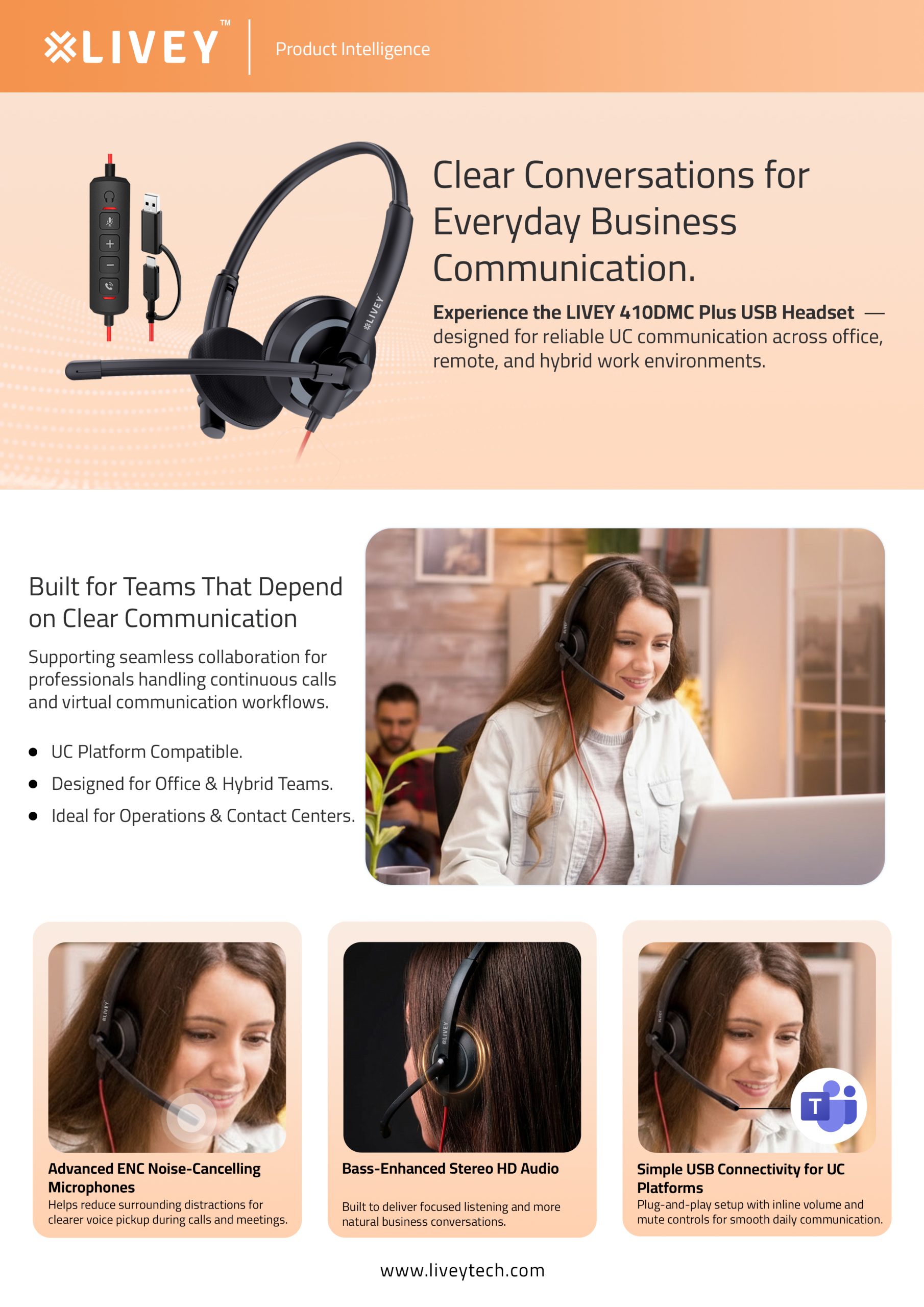
The LIVEY 410DMC Plus is built around a practical business communication need:
making conversations clearer, simpler, and more reliable throughout the workday.
Instead of focusing only on specifications, the headset is designed to reduce communication friction during real-world workflows.
Key capabilities include:
Advanced ENC noise-cancelling microphones for clearer voice pickup
Bass-enhanced stereo HD audio for more focused listening
USB plug-and-play simplicity for dependable connectivity
Inline volume and mute controls for faster call handling
UC platform compatibility for seamless collaboration across work environments
Together, these features help reduce distractions that slow communication down during everyday operations.
Better Communication Creates Better Workflow Stability
In fast-moving environments, teams don’t have time to constantly repeat conversations or re-confirm information.
They need communication systems that work consistently throughout long work sessions.
When audio becomes clearer and more stable:
collaboration feels smoother
conversations move faster
teams stay focused longer
communication fatigue reduces
workflows become more predictable
The impact extends beyond calls themselves.
It affects how efficiently teams work together throughout the day.
Productivity Starts with Communication Clarity
Organizations often look at productivity through the lens of processes, software, and automation.
But communication remains the foundation underneath all of it.
When communication quality improves:
fewer repetitions happen
understanding becomes faster
collaboration becomes easier
work flows more naturally
The LIVEY 410DMC Plus is designed around that exact understanding: clear conversations are not just a communication advantage — they are part of operational efficiency itself.
Because productivity improves when conversations are understood clearly the first time.
GET IN TOUCH
Experience LIVEY for your Business
For more information on our “Products, Partnership Enquiries, FREE Sample Requests” feel free to get in touch with us.